JAMA Network Open Manuscript Submission and Review System
Welcome to JAMA Network Open's Online Manuscript Submission and Review System. To ensure proper
functionality of this site, both JavaScript and cookies must be enabled in your browser.
Current Status:Decision in ProcessStatus Date: 15 Oct 2026Submitted: 10 Jul 2026Article Type: Original InvestigationManuscript Word Count: 2,564
Epidural Electrical Stimulation Promotes Motor Recovery in Severe Acute Cervical Spinal Cord Injury: A Nonrandomized Clinical Trial
Li Wenbo, MD Candidate; Wang Qingyuan, MS Student; Wang Siming, PhD Candidate; Li Cong, PhD; Ge Tongfei, MD Candidate; Deng Mingyang, MS Student; Xiong Wu, PhD Candidate; Cai Bowen, MD Candidate; Wu Jiayang, MS Student; Qin Tao, MD Candidate; Yao Li, BS; Zhou Yan, BS; Yin Guoyong, PhD; Fan Jin, PhD
Epidural Electrical Stimulation Promotes Motor Recovery in Severe Acute Cervical Spinal Cord Injury: A Nonrandomized Clinical Trial
Authors
Li Wenbo, Wang Qingyuan, Wang Siming, Li Cong, Ge Tongfei, Deng Mingyang, Xiong Wu, Cai Bowen, Wu Jiayang, Qin Tao, Yao Li, Zhou Yan, Yin Guoyong, Fan Jin
Keywords
Spinal cord injury; epidural electrical stimulation; neuromodulation; motor recovery; proteomics
Abstract
Importance
Epidural electrical stimulation may improve motor recovery after spinal cord injury, but its efficacy in acute cervical injury and the mechanisms underlying non-response are unclear.
Objective
To evaluate the efficacy and safety of epidural electrical stimulation in acute traumatic cervical spinal cord injury and to identify proteomic biomarkers of treatment response.
Design, Setting, and Participants
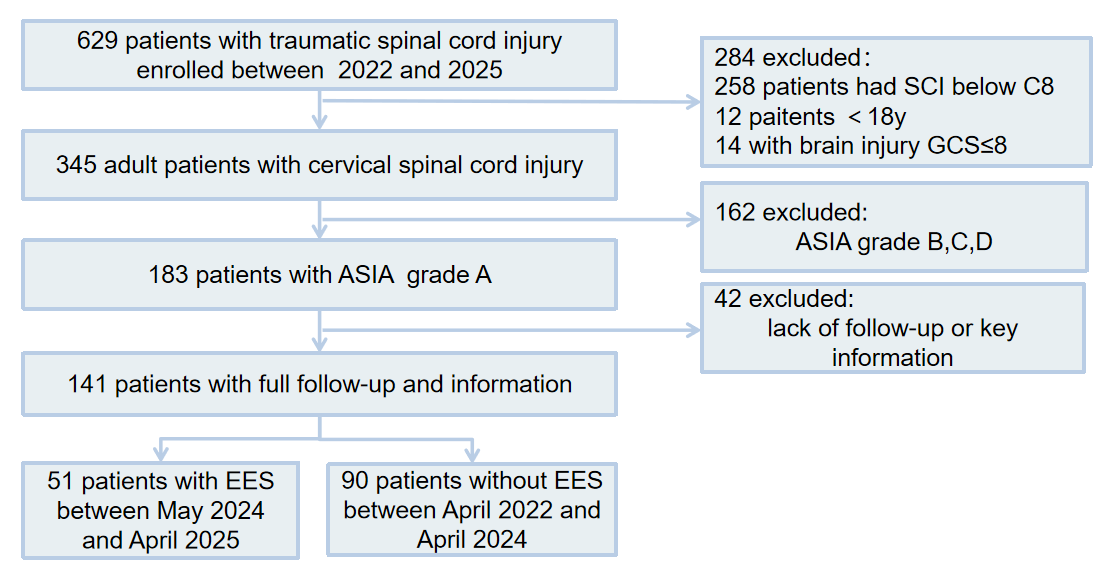
Nonrandomized clinical trial with a prospective intervention group and a mixed control group (historical and concurrent non-intervention patients), conducted from January 2022 to August 2025 at Jiangsu Province Hospital. A total of 141 consecutive patients with acute traumatic cervical spinal cord injury (AIS grade A) were enrolled: 51 received epidural electrical stimulation plus standard care and 90 received standard care alone.
Intervention
The intervention group underwent posterior decompression, implantation of a high-density epidural electrode array, and active stimulation optimized by intraoperative free-run electromyography. Controls received conventional surgery and standard care alone.
Main Outcomes and Measures
Primary outcomes were motor (AIS motor score, Upper Extremity Motor Score) and sensory function, and functional independence (Spinal Cord Independence Measure) at 1, 3, and 6 months. Safety outcomes included acute and chronic complications. Cerebrospinal fluid proteomics identified differential pathways between responders and non-responders.
Results
At 1 month, the stimulation group had greater sensory improvement (AIS sensory: 56.67 vs 52.67; P = .005). At 3 months, motor scores improved more (AIS motor: 28.49 vs 24.12; P < .001; Upper Extremity Motor Score: 27.92 vs 23.76; P < .001). At 6 months, functional independence was higher (Spinal Cord Independence Measure: 45.30 vs 40.35; P = .011). Stimulation increased ventilator weaning (90.2% vs 65.6%; odds ratio = 0.19; P = .0018) and reduced muscle spasms (2.0% vs 20.0%; odds ratio = 9.19; P = .0344). Proteomics linked non-response to downregulated glycan metabolism pathways.
Conclusions and Relevance
Epidural electrical stimulation was associated with enhanced sensorimotor recovery, functional independence, and fewer complications in acute cervical spinal cord injury. Non-response linked to impaired glycan metabolism offers a potential stratification biomarker.
Trial Registration
Chinese Clinical Trial Registry Identifier: ChiCTR2500095515
Submitted Files
Files uploaded with the original submission on 10 Jul 2026. The manuscript PDF is the version used for editorial assessment.
Manuscript is with the editor for a decision. No external peer review was initiated.
16 Jul 2026
With Editor
Assigned to the handling editor for editorial assessment. The manuscript remained with the editor and was not sent for external review.
13 Jul 2026
With Editorial Office
Initial editorial and technical checks completed.
10 Jul 2026
Submitted
Manuscript received by the JAMA Network Open editorial office.
Editorial Assessment
External Peer Review
Not initiated
Reviewers Assigned
0
Current Status
Decision in Process
Status Date
15 Oct 2026
With Editor Since
16 Jul 2026
Last Editorial Action
Decision in Process
This manuscript did not enter external peer review. It has been handled by the editor since 16 Jul 2026 and entered the decision process on 15 Oct 2026.
Correspondence
Editorial status update — decision in process
15 Oct 2026 · From: JAMA Network Open Editorial Office
Your manuscript is with the editor for a decision. No external peer review was initiated. You will be notified when the decision is available.
Editorial assessment complete
16 Jul 2026 · From: JAMA Network Open Editorial Office
Your manuscript has been assigned to a handling editor for editorial assessment.
Submission confirmation — JNO-26-08417
10 Jul 2026 · From: JAMA Network Open Editorial Office
Thank you for submitting your manuscript to JAMA Network Open. Your submission has been received.